Showing posts with label Indexing. Show all posts

Lucene.Net Logical Index Structure

In the index file data are kept as Documents. Each document contains several fields that consist of name and value pairs. Therefore index file have several documents stored and each document contains several fields.

Fields are used to keep information in different ways in the indexed file. There are four types of field types.

They are listed in the below table with the description of the field type.

Field Type

Description

Keyword

Constructs a string value field that is not tokenized, but is indexed and stored. Therefore it is useful for non-text fields and for fields which we want to keep information as it is. Therefore name of the video file is keep in a this type of field

Text

Constructs a string value field that is tokenized, indexed and stored. Information in this type of field will return with hits. These types of fields are useful to keep content in a video frame.

UnIndexed

Constructs a string value field that is not tokenized nor indexed, but is stored in the index

UnStored

Constructs a string value field that is tokenized and indexed, but is not stored in the index


Lucene.Net Index Building Process

Index building process is the process of indexing given to the index files. Before index given data, those data are analyzed by an analyzer. During the analyzing process given data strings are tokenized to tokens. Then the case of the all the tokens are turned to the lower case using the lower case filter. After that stop words are removed using Stop word filter.

The below English words are considered to be Stop words.


"a", "an", "and", "are", "as", "at", "be", "but", "by", "for", "if", "in", "into", "is", "it", "no", "not", "of", "on", "or", "s", "such", "t", "that", "the", "their", "then", "there", "these", "they", "this", "to", "was", "will", "with"


Finally those lower case letters are stemmed using the porter stemmer. After that Index Writer will writes the stemmed words to the index file.

Stemming

Stemming process plays a major role in Indexing applications. In most cases more than one word have similar semantic interpretations and can be considered as equivalent for the purpose of Information Retrieval applications .Due to that Stemmers have been developed reduce a word to it’s root form. Stemming is the process for reducing inflected (or sometimes derived) words to their stem, base or root form – generally a written word form. The process of stemming, often called conflation, is useful in search engines for indexing and other natural language processing problems.

For example a stemmer for English should identify the string "cats" (and possibly "catlike", "catty" etc.) as based on the root "cat", and "stemmer", "stemming", "stemmed" as based on "stem". A stemming algorithm reduces the words "fishing", "fished", "fish", and "fisher" to the root word, "fish".

Stemming process contains few steps to stem a given word.

In the first step use for removal of plurals and -ed or -ing.

e.g.

fishing -> fish, feed -> feed, agreed -> agree

In the next step turns terminal y to i when there is another vowel in the stem. Next step use to maps double suffices to single ones. so -ization maps to -ize etc.

In the fourth step deals with -ic-, -full, -ness etc in the same way as in step three. Fifth step is used to remove -ant, -ence etc from the given word.

In indexing application when a word is given to index, application first calls the Stemmer class and then indexed the stemmes word.

By doing stemming process we can save space and reduce response time since we use single key instead of several keys.

Lucene for Indexing Applications

Lucene is a opensource information retrieval library. It is originally designed in Java, but has been ported to programming languages including Delphi, Perl, C++, Python, Ruby, PHP and C#.

It can be used for any application which requires full text indexing and searching capability.

The key classes that we will use to build a search engine.

  • Document - The Document class represents a document in Lucene. We index Document objects and get Document objects back when we do a search.
  • Field - The Field class represents a section of a Document. The Field object will contain a name for the section and the actual data.
  • Analyzer - The Analyzer class is an abstract class that used to provide an interface that will take a Document and turn it into tokens that can be indexed. There are several useful implementations of this class but the most commonly used is the StandardAnalyzer class.
  • IndexWriter - The IndexWriter class is used to create and maintain indexes.
  • IndexSearcher - The IndexSearcher class is used to search through an index.
  • QueryParser - The QueryParser class is used to build a parser that can search through an index.
  • Query - The Query class is an abstract class that contains the search criteria created by the QueryParser.
  • Hits - The Hits class contains the Document objects that are returned by running the Query object against the index.

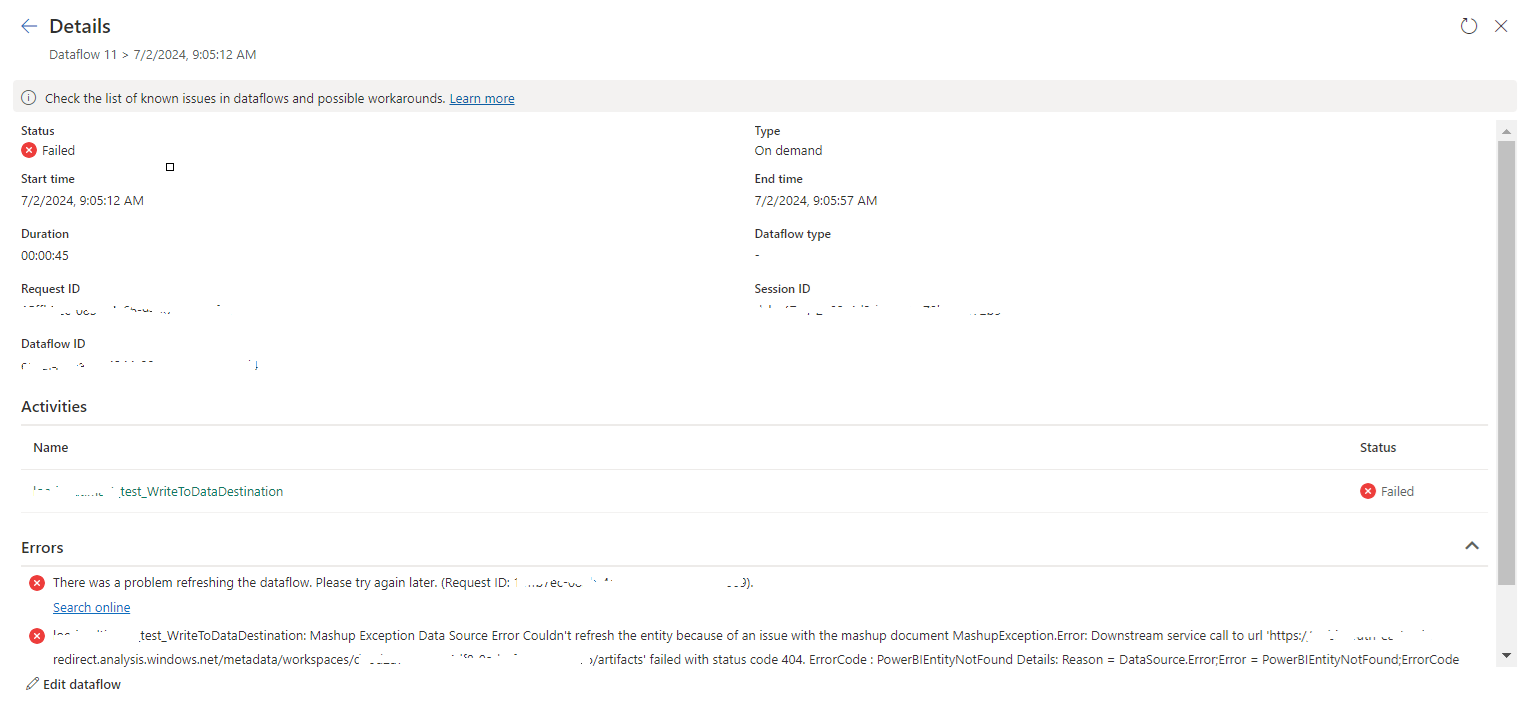
tablename_WriteToDataDestination: Mashup Exception Data Source Error Couldn't refresh the entity...

 Once a Dataflow is created and published on Fabric, got the below error while refreshing the Dataflow. tablename_ WriteToDataDestination: M...